Last updated November 18, 2026
Seasonal ADU Care for North Las Vegas: Year-Round Homeowner’s Guide
Here’s the counterintuitive part: the North Las Vegas ADU that fails first is almost never the one with a structural defect. It’s the one whose HVAC condensate drain was never cleared before July, whose stucco hairline cracks let monsoon water into the sheathing, and whose exterior hose bib wasn’t drained before the one week in January when the temperature dropped below 28°F. This guide runs on a North Las Vegas climate calendar, not a national template. By the end you’ll have a month-by-month schedule, a post-storm inspection list, a freeze protocol, and the documentation habits a landlord or future seller needs to prove the unit was kept to code-compliant standards.
Quick Answer
ADU care in North Las Vegas follows three seasonal threats: the summer heat load from June through September, the monsoon moisture window in July and August, and the freeze risk in December and January. Service the HVAC before May, inspect flashing, stucco and foundation after the first heavy monsoon storm, check refrigerant and paint in October, and drain exposed fixtures before the first freeze. Keep a photo record of every service visit; it’s the evidence that the unit was maintained, and it matters at resale and at any code inspection.
Table of Contents
- Why North Las Vegas ADUs Need Their Own Maintenance Calendar
- May: The Pre-Heat-Season Checklist
- July – August: The Monsoon Moisture Window
- October: The Post-Summer Inspection
- December – January: The Freeze Protocol
- What to Photograph and Keep: Annual Documentation
- Common Mistakes to Avoid
- When to Call a Professional
Why North Las Vegas ADUs Need Their Own Maintenance Calendar
North Las Vegas sits in a high-desert basin where the same building envelope faces 105°F afternoons in July and a hard freeze in January. Stucco moves across that range. Sealant joints open. Concrete flatwork expands and then can’t fully recover. An ADU is a smaller structure than the main house, which means its roof area, wall mass and slab respond to temperature swings faster, and small failures show up sooner. A detached unit under 500 square feet shoulders a proportionally bigger heat load per square foot because there’s less interior volume to buffer the attic heat that builds by early afternoon.
That’s why a national maintenance checklist written for a temperate climate is a poor fit. It tells you to “winterize” and “service the AC annually” and leaves it there. California’s climate-zone guidance is equally mismatched: coastal ADUs see marine humidity that inland North Las Vegas units never get, and they rarely see the summer UV that chalks exterior paint here. A North Las Vegas ADU needs attention scheduled to its actual seasons, with a monsoon window and a freeze window that national guides don’t name.
If your unit came out of a garage conversion or a detached build, the envelope details matter as much as the schedule. Garage conversion ADUs often keep a slab and stucco from the original structure, which means older waterproofing is now under habitable space. New detached units, especially modular and prefab systems, carry a manufacturer service schedule alongside the climate schedule. Our teams verify both when the unit is commissioned, and we hand the homeowner the file. You can see the categories we track on the Ellery ADU Studio North Las Vegas home page.
May: The Pre-Heat-Season Checklist
May is the month that decides whether your ADU survives June through September without an emergency call. By late June a North Las Vegas HVAC unit in an ADU will run 14 or more hours a day without stopping. Service done in the mild weeks before that load arrives is the cheapest maintenance you’ll do all year. This is also the last comfortable window to inspect exterior sealant before thermal expansion cycles start opening joints.
- HVAC service before the first 100°F week. Ask specifically for coil cleaning, refrigerant charge verification and a condensate drain clear-out. Clogged condensate lines are the top cause of summer water damage inside ADUs, and a line that ran fine last fall can clog over a dry winter here. Confirm the technician reads and resets the float switch.
- Filter replacement and airflow check. In a small ADU, a dirty filter chokes airflow fast. Replace it and verify each supply register moves air. Stagnant airflow to one room is an early sign of duct leakage or a damper issue.
- Attic ventilation inspection. Confirm soffit vents aren’t blocked by insulation and ridge or gable vents are clear. In a North Las Vegas attic that hits 150°F by July, vented heat is the difference between an HVAC system that strains and one that cycles. A detached ADU with a low-slope roof may rely on a single powered vent; test it.
- Exterior caulk and sealant inspection. Walk the walls and run a finger along each joint. Any caulk that’s cracked, shrinking or pulling away from the stucco gets redone before the expansion cycles of summer widen it. Pay special attention to window and door perimeters, plumbing penetrations and the top-of-wall transition.
- Gutter and roof-edge clearing. Clear winter debris from gutters and downspouts so the first monsoon rain has somewhere to go. Check that downspouts discharge at least four feet from the foundation.
We schedule pre-heat-season inspections in April and May for North Las Vegas clients because the calendar is unforgiving: an HVAC breakdown in the second week of July, in an occupied ADU, is a genuinely bad week. The ADU Design & Permitting in North Las Vegas documentation you received at project closeout often lists the equipment model and service intervals; keep it with this checklist.
July – August: The Monsoon Moisture Window
North Las Vegas receives most of its meaningful rainfall in July and August, often in short, high-intensity bursts that overwhelm a drainage path used once or twice a year. A monsoon storm can drop more water in a half hour than the unit saw in the previous six months. That’s not a durability problem. It’s a schedule problem: the ADU needs inspection right after the first heavy storm, before slow leaks become permit-required repairs.
- Inspect after the first heavy storm, not after the season. Walk the unit within 24 hours. Standing water at the foundation perimeter, water staining on stucco below the roofline, or moisture inside a closet on an exterior wall are all indicators. Photograph what you see, even if it looks cosmetic.
- Check roof flashing at every penetration. The vulnerable spots are vent stacks, skylights if present, the roof-to-wall junction and the edge metal. Look for lifted or separated flashing, missing sealant and debris damming water at the edge.
- Look at the stucco with a low raking light. Hairline cracks that were cosmetic in May can open enough to admit wind-driven rain in a monsoon. Cracks wider than a credit card’s edge, or any crack showing dark staining, get sealed and documented.
- Walk the foundation perimeter. Confirm water drains away from the slab, not toward it. If soil has settled and the grade now pitches toward the ADU, regrade the first three feet. Standing water against a slab finds the path of least resistance, especially on conversions where the original slab edge is still exposed.
- Test the interior for moisture. Check baseboards on exterior walls for swelling, and sniff test rooms that share walls with the exterior. A musty smell in an ADU closet after a monsoon is a signal, not a quirk.
What we watch for in North Las Vegas monsoon damage: staining at the wall-roof junction that runs below the roofline and stops mid-wall (water tracking down a stucco plane), and efflorescence on the slab edge, which is moisture moving through concrete rather than sitting on it. Both are cheap problems if caught in July and permit-required repairs if left until November. When the fix involves openings, extending a structure, or replacing waterproofing, that work needs permits and specifications. Our New Detached ADU in North Las Vegas work includes envelope detailing designed for this monsoon pattern.
October: The Post-Summer Inspection
October in North Las Vegas is relief for you and a reckoning for the building. Once the daily highs drop below 90°F, you can inspect the ADU for what summer actually did. This is the second-most important service month of the year after May. Skip it and the next failure shows up in a January cold snap when nobody wants to be on a ladder.
- HVAC refrigerant depletion signs. If the unit struggled to keep up in late August, or you noticed ice on the refrigerant line at any point, have the charge checked before winter. A slow leak shows up as a system that runs constantly and can’t hit setpoint. Refrigerant handling is licensed work; don’t have anyone top off a charge without leak detection first.
- Exterior paint chalk-off. Run a dry hand across a sunny south or west wall. A white residue on your palm means the paint is chalking, which is UV breakdown of the coating. Chalking paint protects poorly and will fail faster than flat paint on shaded walls, so plan repainting on the sun-facing planes first. James Hardie fiber cement siding holds paint well but still needs caulk joints checked; stucco takes the brunt of UV directly.
- Concrete flatwork cracking. Look at slabs, walkways and patio surfaces on the ADU’s footprint. Hairline cracks are normal. Cracks that have widened, show vertical offset between the two sides, or run to the foundation are worth a professional look. The summer heat cycle in North Las Vegas is the harshest stress flatwork sees all year.
- Caulk and weatherstripping recheck. The joints you sealed in May have been through a full expansion cycle. Inspect again and touch up anything that opened.
- Drainage recheck. Clear leaf and debris buildup from the storm-water path and confirm the grade still pitches away.
Prefab and modular units need the same treatment with one addition: check the manufacturer’s scheduled service items. Systems from Mighty Buildings, Boxabl and Plant Prefab each carry a set of panel, seam and service-point checks that the installer should have documented. If you don’t have that file, call us before you guess. We’ll tell you what the manufacturer expects and what the climate asks for, and if you’ve had work done elsewhere, a free second opinion on any written estimate you already hold is yours.
December – January: The Freeze Protocol
North Las Vegas winters are mild enough that freeze protection feels optional, which is exactly why it gets skipped. The basin averages a handful of nights each winter at or below 28°F, and one of those nights is all a poorly insulated pipe needs. Two consecutive sub-28°F nights will freeze an exposed hose bib or a pipe running through an uninsulated exterior wall. The repair typically costs more than a decade of prevention.
The risk profile depends on how your ADU is built. Slab-on-grade detached units and garage conversions on slab are the most exposed. The plumbing runs through the slab and along exterior wall assemblies, and the pipe closest to the exterior face of the wall is the one that freezes first. Nevada ADU wall construction typically stacks stucco, a weather barrier, sheathing, framing with insulation and drywall. The weak point is not the wall cavity; it’s the penetration where the pipe passes through and any section run outside the insulated envelope. On a conversion, the garage’s original construction rarely insulated the exterior wall to today’s standard, so the pipe in the bottom plate of an exterior wall is often the coldest spot in the unit.
Which fixtures are most exposed in slab-on-grade units: exterior hose bibs, the ice maker line if the refrigerator backs to an exterior wall, the water heater in an uninsulated closet, and any shower or sink fixture on an exterior wall in a north-facing room.
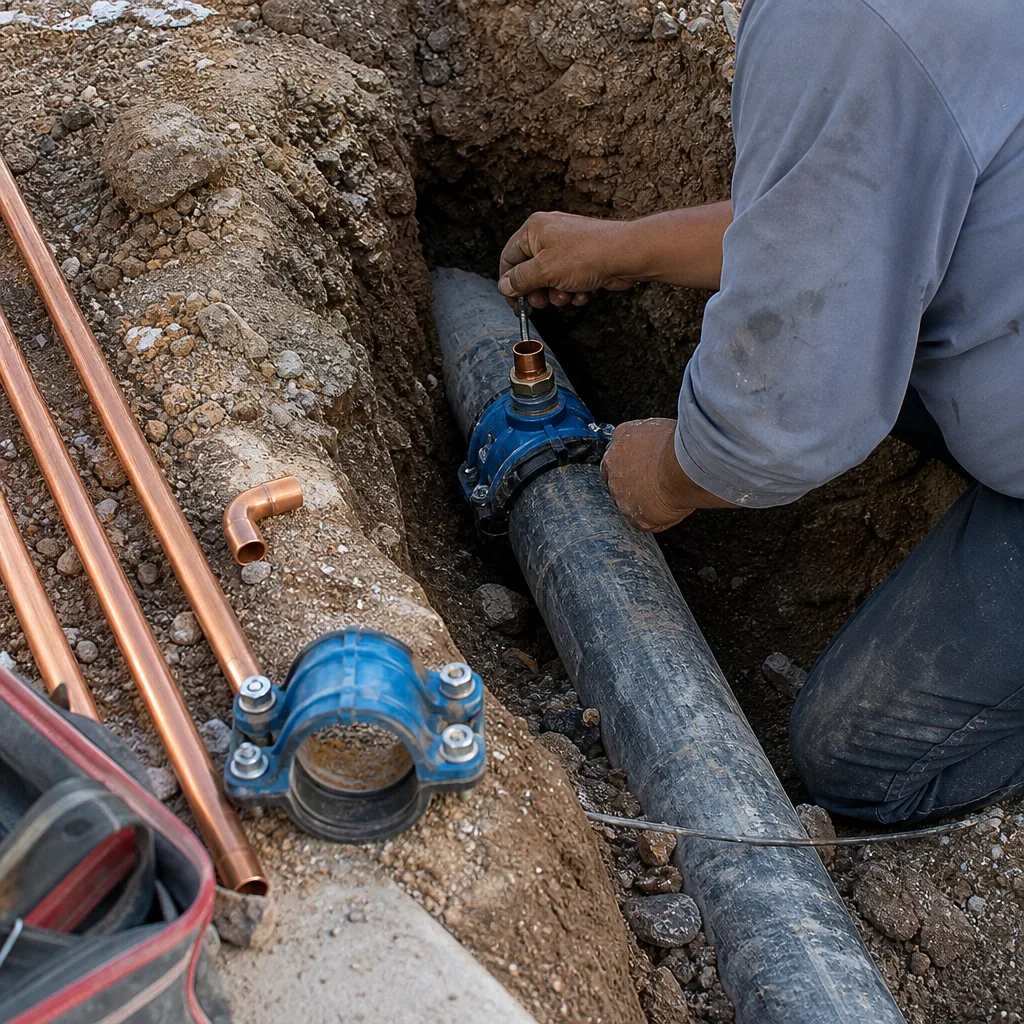
- Before the first freezing night: disconnect hoses and drain exterior hose bibs. If the bib has an interior shutoff, close it and open the bib to drain the line.
- Check pipe insulation on every accessible run through unheated spaces, including the attic access, garage wall and water heater closet. Insulation that’s split or missing gets replaced.
- During a freeze event: open cabinet doors under sinks on exterior walls, and let a drip run on the coldest fixture overnight. A moving drop of water beats a frozen pipe.
- Shut-off valve: confirm every household member knows where the main water shutoff is and that it turns freely. On a freeze break, closing it in the first minute prevents most of the damage.
- After the thaw: check the slab edge and wall base for new moisture, and confirm the water heater and fixtures run normally. Photograph anything you find.
We include pipe routing and insulation detail in the Garage Conversion ADU in North Las Vegas scope precisely because original garage construction doesn’t anticipate a slab freeze. Our technicians have up to 11 years of experience with the assemblies used in this climate and can tell you which sections of your unit are the exposed ones.
What to Photograph and Keep: Annual Documentation
Maintenance records are only useful if they’re organized. A future seller or an inspector wants to see a service picture, not hear a story. The standard should be a photo record plus the paper trail, filed in one place, updated on every visit. That’s the same standard we hold ourselves to: every Ellery ADU Studio visit ends with a documented photo record the client receives.
Build a file (digital is fine) organized by year, with these items:
- Pre-season and post-storm photos of the roof, every wall plane, the foundation perimeter and any interior wall that shows moisture. Timestamp them. A dated photo before and after repair is the strongest record.
- HVAC service reports showing date, technician company, work performed, readings and refrigerant levels. Keep the filter-change dates separately.
- Caulk and paint records with product names and dates. Know what the exterior was painted in and when.
- Freeze-protection actions for each winter: what was drained, when, and what was insulated.
- Written scope and invoices for every repair, plus the original permit set and any subsequent permit paperwork. If waterproofing, structural or drainage work was done, the permitted drawings belong in the file.
- Manufacturer service records for modular and prefab components, including anything specified from Abodu, Cover or Tuff Shed, and the installer’s closeout package.
This file is evidence. It shows the unit was maintained to code-compliant standards, and it answers a buyer’s due-diligence questions without a rebuild of the history. It’s also what a written warranty depends on. Under our 365-Day Done Right Promise, the paperwork matters to both sides. If a future sale is on your horizon, the same file supports the disclosure.
Common Mistakes to Avoid
- Running the HVAC without a pre-season service. A unit that’s fine in April can clog a condensate line by July. The service visit costs a fraction of the water-damage repair and the emergency call in a heat wave.
- Skipping the post-monsoon inspection. Inspect after the first heavy storm, not after the season. Water that gets into stucco or sheathing in August becomes a permit-required repair by November, and the difference in cost is significant.
- Treating exterior caulk as a one-and-done fix. In a North Las Vegas summer, sealant joints expand and contract hundreds of times. Caulk is annual maintenance here, not a permanent repair.
- Assuming the freeze risk is negligible because “it’s the desert.” The basin sees sub-28°F nights most winters. One frozen hose bib line in a slab-on-grade ADU is enough to soak a wall, and most homeowners find it after the thaw, not during.
- Letting the grade pitch toward the ADU. A quarter-inch of settlement at the slab edge can turn a downpour into a mini-flood. Walk the perimeter after every wet season and regrade the first three feet if the pitch has turned.
- Ignoring manufacturer service items on a prefab or modular unit. Panel seams, service points and sealants on a modular unit carry their own schedule. Missing them can void the manufacturer’s coverage and shift later repair cost to you.
- Not photographing anything. A maintenance history that lives only in memory doesn’t help the future seller, the inspector or the warranty. Keep the file.
When to Call a Professional
Call a professional when the issue crosses into systems or structural territory. That includes any HVAC repair involving refrigerant, an electrical fault, water that’s gotten past the sheathing or weather barrier, a roof penetration leak requiring flashing replacement, foundation cracks with vertical offset, and any repair that would need a permit. Those aren’t jobs for a Saturday afternoon. They also aren’t jobs that a general handyperson should touch: the workmanship warranty and the documentation trail depend on the right trade following the right specification.
A North Las Vegas ADU also needs a professional whenever the seasonal checklist turns up something you can’t document yourself. That’s a diagnosis question, not a repair decision. Ellery ADU Studio North Las Vegas offers free estimates in North Las Vegas, and every project comes with a written price before any work begins. Call (866) 403-8955 for a free estimate and to schedule an inspection on your ADU’s own calendar.
Frequently Asked Questions
Twice a year for HVAC and a full envelope inspection twice: once in May before the heat season and once in October after it. Add a post-monsoon inspection in July or August if a heavy storm occurred, and a freeze-protection check before the first sub-32°F night. That’s roughly four proactive visits a year, more if your unit is on a manufacturer’s schedule. Call (866) 403-8955 for a free estimate on putting that schedule in place.
Yes. The basin averages several nights each winter at or below 28°F, and one event is enough to freeze an exposed hose bib or a pipe in an uninsulated exterior wall. Slab-on-grade ADUs are the most exposed, especially those converted from existing garages where the original wall assemblies weren’t insulated to today’s standard. The protection is cheap and takes an hour: drain the bibs, check the insulation, know the shutoff location. Call (866) 403-8955 for a free estimate if you’d like us to walk the exposed runs.
It depends on how quickly it’s caught. A re-caulk and flashing seal after the first storm runs in the low hundreds of dollars. Water that reaches the sheathing and requires opening the wall is a different job with a permit and a written price. For a firm number, we write a line-item estimate before any work starts. Call (866) 403-8955 for a free estimate, and if you already have a written estimate from someone else, request our free second opinion.
Sometimes, and it’s the reason to call rather than patch. Cosmetic caulk and paint don’t need a permit. Replacing a section of sheathing, structural or drainage work, and any change to the weather barrier or the building envelope do. The written estimate should tell you which category your repair falls into before you sign, and our projects pull the permits and pass inspection by contract. Call (866) 403-8955 for a free estimate.
Keep the installer’s closeout package, the manufacturer’s service schedule (for a unit from Mighty Buildings, Boxabl or Plant Prefab that’s specific to their systems), dated photos of the roof and walls on every service visit, and invoices for every repair. If a manufacturer’s scheduled service item wasn’t performed, document why and the date it was resolved. Call (866) 403-8955 for a free estimate and we’ll tell you which records we need to see.
Not on a project that starts with a written price. Under Haven Standard Clause 1, every project is quoted in writing before any work begins, and the scope is fixed. That means no door-side upsells and no scope creep once the crew is on site. The clause is the reason our clients can read a number and plan around it. Call (866) 403-8955 for a free estimate.
The Bottom Line
A North Las Vegas ADU survives on its schedule, not on luck. May service decides the summer, the monsoon inspection decides whether small water intrusion stays small, October is your only chance to catch the summer’s damage before winter, and the freeze protocol protects the plumbing that North Las Vegas homes assume they don’t need to think about. Add a photo record on every visit and you have a maintenance history that proves the unit was kept to standard. The three threats are predictable, the checks are cheap, and the work that goes wrong is the work nobody put on a calendar.
Written by the team at Ellery ADU Studio North Las Vegas.