Last updated November 18, 2026
ADU Warning Signs: A North Las Vegas Homeowner’s Reference Guide
Most ADU warning-sign lists describe what a general contractor sees on a walkthrough: a sagging roofline, a water stain on the ceiling, a hairline crack wandering across the slab. Those matter. But the problems that actually cost North Las Vegas homeowners money tend to be invisible from the driveway. They live in the permit file, the certificate of occupancy, and the utility records. One local owner bought a property with an existing ADU, then found at refinance that the unit carried a certificate of occupancy for a storage structure, not a dwelling. The building was fine. The paperwork was not. The lender required a full re-permit before closing. This guide walks through what to verify, in order, so that discovery does not happen on someone else’s timeline.
Quick Answer
The biggest ADU warning signs in North Las Vegas are documentation problems, not structural ones: a certificate of occupancy that lists the unit as storage or accessory space rather than a dwelling, a permit issued with no final inspection on record, an electrical subpanel that was expanded without a permit, and an HOA covenant that was never checked. Physically, watch for stucco efflorescence, DIY refrigerant linesets, and utility connections with no inspection record. If any of these turn up, get a professional review before you buy, refinance, or list.
Table of Contents
- How to Verify the Certificate of Occupancy for an Existing ADU
- Physical Warning Signs Specific to Nevada ADU Construction
- Permit History Red Flags in the North Las Vegas Database
- HOA and CC&R Warning Signs
- The Documents a Seller Should Be Able to Produce
- Electrical Panel and Utility Connection Clues
- A Five-Step Verification Order for Buyers
How to Verify the Certificate of Occupancy for an Existing ADU
A certificate of occupancy – the CO – is the city’s written statement that a structure may legally be used for its stated purpose. For an ADU, the CO must describe a dwelling unit: living space with cooking, sleeping, and sanitation. If it says “storage,” “accessory structure,” “workshop,” or “garage,” the unit was never legally converted to a residence, no matter how finished it looks inside.
The lookup path in North Las Vegas runs through the city’s online permit portal. You can search by street address or by permit number. What you want to see is a permit record that shows the project type as an accessory dwelling unit or a residential conversion, followed by an inspection history that ends with a recorded final inspection and a CO issued against that permit.
A valid CO for a dwelling unit will typically show:
- A project description naming residential occupancy, not storage or accessory use
- A final building inspection with a passed status and a date
- Separate sign-offs for electrical, plumbing, and mechanical where those trades were involved
- A finished square footage and bedroom/bath count that matches the physical unit
If the portal shows a building final but no trade finals, or shows a CO tied to a storage structure, treat that as a documentation failure even when the unit is occupied. Our ADU Design & Permitting in North Las Vegas work starts with this exact audit, because a permit set that does not close out cleanly becomes the next owner’s problem.
Physical Warning Signs Specific to Nevada ADU Construction
Nevada’s climate leaves a particular fingerprint on a badly built or unpermitted ADU. The desert swing between hot days and cool nights, combined with the summer monsoon pushes in July and August, stresses exterior assemblies in ways that show up visibly. Three patterns are worth knowing.
Stucco efflorescence
White, chalky staining on stucco – efflorescence – is salt drawn to the surface by moisture moving through the wall. In North Las Vegas, a little of it near a hose bib or a downspout is normal. A broad bloom across a wall face, especially below window heads or along a wall that gets no direct rain, suggests water is getting in behind the cladding. That usually points to missing weep screed, an improperly lapped weather-resistive barrier, or a flashing detail that was improvised. Once water sits behind three-coat stucco in this heat, the damage underneath is invisible until the paper fails.
HVAC linesets with evidence of DIY refrigerant work
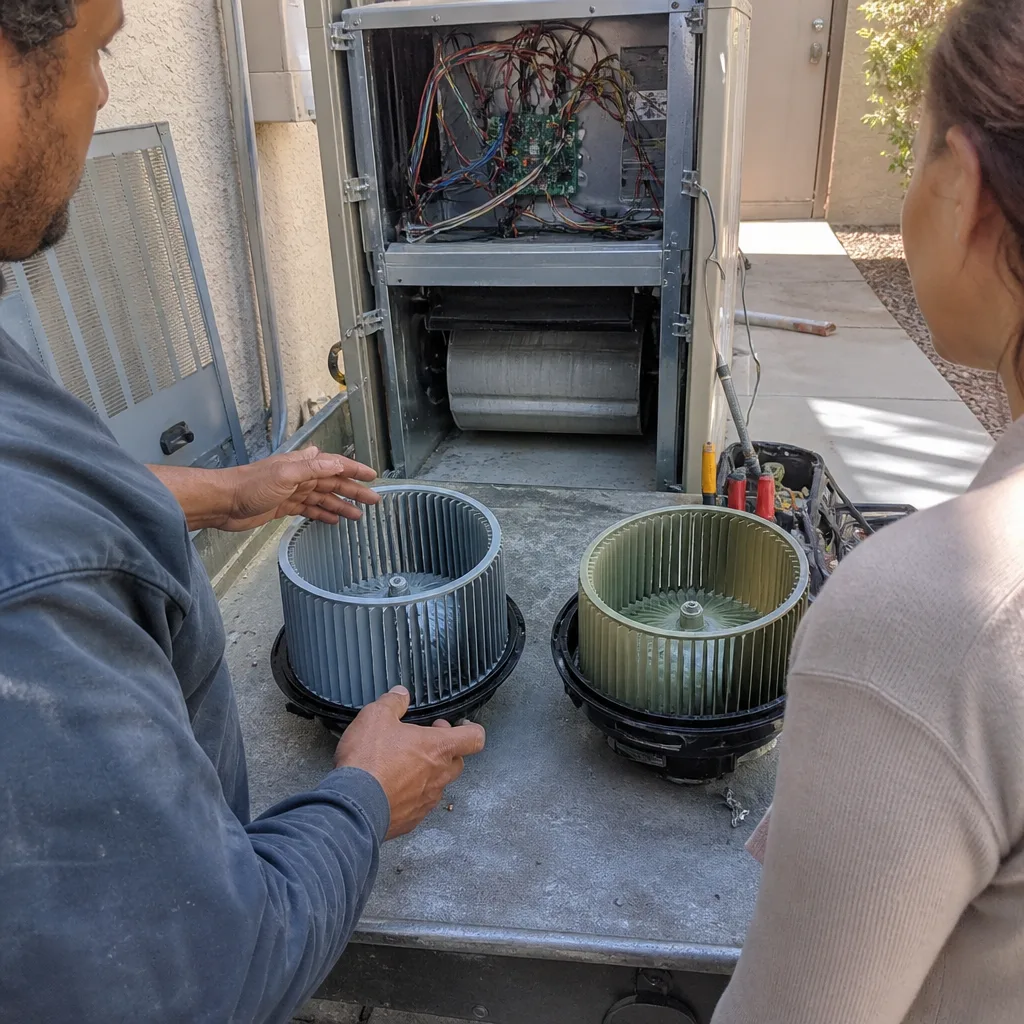
The refrigerant lines running from condenser to air handler should be insulated, neatly bracketed, and show no signs of having been cut and re-brazed. Look for mismatched insulation, unsealed penetrations through the wall, exposed copper near the valve, and a condenser that sits on a plastic pad poured well after the slab was finished. In North Las Vegas, where a mini-split is the common choice for an ADU, an unpermitted install frequently means the equipment was sized by guesswork, and the electrical circuit feeding it may not match the nameplate rating.
Electrical expansion without a paper trail
A subpanel added to feed the ADU is normal. A subpanel added with no permit, no load calculation, and breakers that do not line up with any panel schedule is not. We’ve opened panels in older North Las Vegas neighborhoods where the subpanel feeding a backyard unit shares a circuit with the pool pump and was never inspected. That is a fire risk and a disclosure item at sale.
Permit History Red Flags in the North Las Vegas Database
When a permit was issued but no final inspection was ever recorded, the project was never formally closed out. This is common. Contractors pull the permit, complete the work, and skip the final because the client stopped calling or the job wrapped while the trades were still catching up. In a database like North Las Vegas’s, an open permit from 2018 sitting against a residential address is a signal worth pulling the full file on.
An open permit means:
- The city has never verified the work meets code
- The CO was never issued, or was issued against a different scope
- A future sale may trigger a code compliance review, and the city can require corrective work
- Some lenders will not close a refinance with an open permit on the property record
Other red flags to look for in the permit history:
- Permit issued, no inspection activity at all. The work may have been done and the permit abandoned, or never done.
- Building final passed, trade finals open. Electrical or plumbing was left unverified.
- Multiple permits for the same structure across different years. Frequently indicates a prior owner added scope without consolidating the paperwork.
- Permit type “accessory structure” on a unit now marketed as an ADU. This is the exact scenario that stalled one North Las Vegas refinance last year.
If you find any of these, our New Detached ADU in North Las Vegas team can pull the file, compare it against the standing structure, and tell you what a clean permit set would need to show.
HOA and CC&R Warning Signs
An ADU can be fully legal with the city and still violate a restrictive covenant. North Las Vegas has a large share of newer planned-community housing built between 2015 and 2024, and many of those associations recorded CC&Rs with rules on accessory structures, secondary kitchens, and long-term rental use.
Signs an ADU may be out of compliance with an HOA or CC&R:
- The ADU has a kitchenette or full kitchen in a community whose architectural guidelines prohibit a second kitchen
- The unit was built without an architectural-review application or an approval letter on file
- The property is in a community that caps the number of rentals, and the ADU was being advertised as a long-term rental
- The setbacks, height, or lot coverage do not match the recorded design guidelines
Consequences can run from a written demand up to an order to remove a structure, plus accrued fines. The information you need lives in the recorded CC&Rs (look up the community’s declaration on the county recorder’s site) and in the HOA’s design guidelines for accessory structures. Read the definitional section first; many ADU conflicts turn on how a “dwelling unit” versus an “accessory structure” is defined in the recording.
The Documents a Seller Should Be Able to Produce
If the seller cannot assemble a full documentation package, the burden of proving legal status shifts to you. Ask for four things. The absence of any one is not automatically fatal, but it is a warning sign that needs an explanation you can verify in the permit portal.
- The permit set – the drawings as submitted to the city, stamped by the reviewing plan checker.
- The approved plans – the same set with the approval stamp and any redlined corrections. These show what was actually approved, not what was drawn.
- The final inspection card or CO – the city’s record that the work was verified in the field and issued against the residential scope.
- Utility connection documentation – records showing water, sewer, and electrical connections to the ADU were inspected. In North Las Vegas this matters, because an uninspected sewer connection to a secondary structure is a property-line and easement question as much as a plumbing one.
If the seller produces a permit set but no final inspection, or a CO but no permit file, assume the paperwork is incomplete until the city confirms otherwise. A free second opinion on a written estimate or documentation package from another firm is worth having before you sign.
Electrical Panel and Utility Connection Clues
Electrical inspection records are the most commonly skipped documents on an ADU, and the problems tend to be invisible until something goes wrong. When you review an existing unit, ask for the panel schedule, the load calculation, and the electrical final inspection. If those are not available, look for these clues in the field.
- Subpanel with no label or schedule. Normal to find a small breaker list, abnormal to find nothing.
- Breaker sizing that does not match the circuit. A 30-amp breaker feeding a 20-amp wire is a sign someone wired to what was on hand.
- Knockouts missing or unfilled. A panel with open knockouts was likely modified after the last inspection, if it was ever inspected.
- Separate meter for the ADU with no utility record of the install. The utility should have a service request against the address.
- Grounding and bonding that was added late. Look for an added ground rod and a bonding clamp on the water line that does not match the age of the electrical system.
Electrical work inside a dwelling is genuinely dangerous, and a panel that was expanded without a permit is one of the few warning signs on this list that can cause a fire. Have a licensed electrician open the panel before you rely on a seller’s assurance.
A Five-Step Verification Order for Buyers
Run these in sequence. The order matters, because each step tells you whether the next one is worth doing.
- Pull the permit history. Search the North Las Vegas permit portal by address. Note every permit against the property, its type, and whether a final was recorded.
- Request the CO. Ask the seller, then verify it in the portal. Confirm the occupancy type reads as a dwelling unit, and confirm the square footage and bedroom count match the standing structure.
- Pull the recorded CC&Rs and design guidelines. If the property is in an HOA, confirm the ADU was reviewed and approved under the recorded rules.
- Inspect the physical signs. Walk the exterior for efflorescence, the HVAC linesets for DIY refrigerant work, and the panel for unpermitted expansion. A documented photo record from a professional walk is more useful than a verbal impression.
- Reconcile everything against the permit set. If the approved plans do not match what was built, that gap is the real risk. Determine whether it can be corrected with a documented revision or whether it triggers a re-permit.
Ellery ADU Studio North Las Vegas runs this exact sequence for buyers and refinancing owners, because the design-build model makes the documentation the product. We’ve designed, permitted, and built more than 900 ADUs since 2015, every one with a written price before work started and a documented photo record on completion. Under Clause 1 of The Haven Standard, the written price is fixed before work starts; under the 365-Day Done Right Promise, if the finished unit is not built to the permitted drawings, we make it right in writing. Browse the Ellery ADU Studio North Las Vegas home page for the full scope of services.
Common Mistakes to Avoid
- Trusting the seller’s description of “legal ADU” without pulling the CO. The word “legal” in a listing means nothing unless the occupancy type in the city file says dwelling. Verify it in the portal, not the marketing.
- Reading the building final as a close-out. A building final inspection without electrical, plumbing, and mechanical finals is an incomplete permit. In North Las Vegas, an open trade final can hold up a sale.
- Assuming the HOA is fine because the city approved it. City review and CC&R review are separate processes. Many North Las Vegas communities built after 2015 have covenants that were never checked against the ADU plans.
- Judging the unit by interior finishes. A tile shower and a nice kitchen tell you nothing about whether the sewer connection was inspected or the subpanel was permitted.
- Skipping the stucco moisture read. Efflorescence does not always show on a dry-day walkthrough, and behind-the-wall moisture is expensive to remediate once the cladding has to come off.
- Taking a contractor’s verbal assurance as the record. Ask for the photo record. Which brings us to the documentation you should always ask for: if the only proof of what was done is a sentence, you do not have proof.
- Waiting until the appraisal to look at any of this. The appraisal is the worst time to discover a documentation problem, because you have lost the leverage to negotiate a fix.
When to Call a Professional
Call us when the certificate of occupancy does not match the standing structure, when an open permit sits on the address, when the seller cannot produce a final inspection card, or when the panel shows signs of unpermitted electrical expansion. Also call if you are buying in a covenant-restricted HOA community and are not sure whether the ADU complied. These are not problems to solve by reading the listing one more time; they are problems that need a permit set and a documented review to close out correctly. If you have already received a written estimate from another firm, we offer a free second opinion on it – no obligation, and we will tell you plainly if the scope is sound. Ellery ADU Studio North Las Vegas offers free estimates in North Las Vegas. Call (866) 403-8955.
Frequently Asked Questions
The most common is a certificate of occupancy that lists the unit as a storage or accessory structure rather than a dwelling unit. It is common because many garage and detached units in North Las Vegas were permitted as storage and later converted without the paperwork following. Verify the occupancy type in the city permit portal before you rely on any other documentation. Call (866) 403-8955 for a free review if the record is unclear.
It means the city never verified that the work was completed to code, and the certificate of occupancy was likely never issued. An open permit can block a refinance, trigger a code compliance review at sale, and leave the trades unverified. Pull the full permit file and confirm what was actually inspected. Call (866) 403-8955 for an estimate on closing it out correctly.
Yes, in most cases. You can search the North Las Vegas permit portal by address, pull every permit against the property, and check whether a final was recorded and whether the CO states a dwelling unit. What is harder to do yourself is reconcile a mismatched permit set against the standing structure, or read an unpermitted panel. That is where a professional review saves money.
Re-permitting an existing ADU in North Las Vegas typically runs $6,000-$22,000 all-in, drawings through final inspection, depending on what was built versus what was approved and whether the HOA is involved. A clean re-issue is on the low end; a structure that requires corrective work and a fresh CO is higher. Every quote we write is a written price before any work starts. Call (866) 403-8955 for an exact quote on your property, and the estimate is free.
Check the stucco for wide efflorescence blooms, the HVAC linesets for signs of re-brazed copper or mismatched insulation, and the electrical panel for missing breaker labels, unfilled knockouts, and breaker sizing that does not match the wiring. In summer, also look for AC condensers sitting on pads that were clearly poured after the slab. Each one is a question that deserves a permit file to answer.
They are separate, and one does not replace the other. A North Las Vegas HOA reviews the project against recorded CC&Rs and design guidelines; the city reviews it against the building code. An ADU can be fully permitted by the city and still violate the covenants, which can lead to fines or a removal order. Pull the recorded CC&Rs and confirm both approvals exist.
The Bottom Line
The ADU problems that cost North Las Vegas homeowners the most are not the ones you can see. They are the permit that was never closed, the certificate of occupancy that names storage instead of a dwelling, the subpanel that was expanded without a load calculation, and the HOA covenant that was never checked. Run the verification order: permits, then CO, then CC&Rs, then the physical read, then reconciliation against the permit set. If anything does not line up, get a professional review while you still have the leverage to negotiate. And remember the four documents to ask for: the permit set, the approved plans, the final inspection card, and the utility connection records.
Call Ellery ADU Studio North Las Vegas at (866) 403-8955 to schedule a free estimate or a free second opinion on any written estimate already in hand. A live person answers calls around the clock, and every review comes with a documented photo record of what we found and what needs to happen next.
Written by the team at Ellery ADU Studio North Las Vegas.