Last updated November 18, 2026
ADU Site Prep & Utilities Troubleshooting: Common Problems and How to Fix Them
The most expensive ADU site prep problem in Clark County is not the problem itself. It’s discovering it at the wrong phase. A caliche ledge found during utility trenching adds $800 – $2,400 to a North Las Vegas project. The same ledge found after the slab is poured adds $8,000 – $15,000 in saw-cutting, excavation, and re-pour costs. The problem didn’t change. The calendar did. This guide catalogs the ten failures that surface most often on North Las Vegas lots, the phase they typically appear in, and the specific resolution path for each, so you can fix the issue without restarting plan check from zero.
Quick Answer
Most ADU site prep problems in North Las Vegas fall into five buckets: utility line conflicts, water pressure or meter capacity denials, soils that demand an engineered foundation, electrical service too small for the ADU load, and sewer capacity holds. Nearly all of them can be resolved through a plan check amendment or a utility-side application rather than a full re-submittal, provided the problem is documented early. The cost of the fix depends less on the defect than on when it’s caught.
Table of Contents
- Utility Locate Reveals a Line Conflict With the Proposed Footprint
- Water Meter Upgrade Denied for Insufficient Line Pressure
- Soils Report Reveals Expansive Clay or Caliche
- Existing Electrical Service Can’t Carry the ADU Load
- Sewer Capacity Hold on Your North Las Vegas Property
- Drainage, Grading, and the Desert Slope Problem
- How to Amend a Plan Set Without Restarting Plan Check
- Common Mistakes to Avoid
Utility Locate Reveals a Line Conflict With the Proposed Footprint
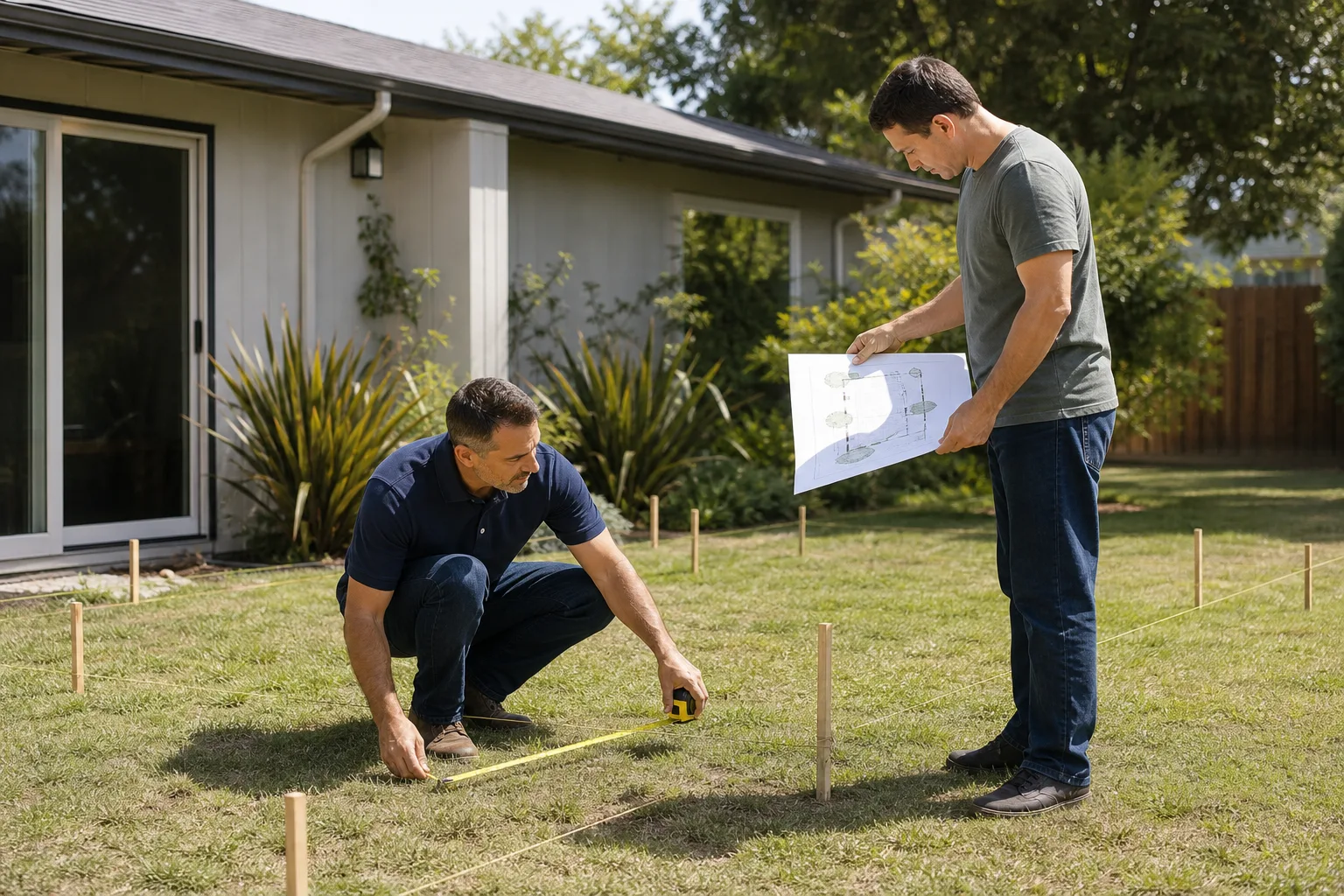
You submit the site plan, the city runs its review, and somewhere in the process a locate mark lands squarely inside the footprint of the new detached unit. A gas service, an irrigation line, or a private sewer lateral sits exactly where the back wall is supposed to go. This is one of the most common problems we see on older North Las Vegas lots, particularly in neighborhoods built out in the 1990s and early 2000s where utility placement followed looser plotting conventions than today’s standards.
The instinct is to redraw the whole ADU. That’s rarely necessary. Here’s the resolution path we walk owners through:
- Request a fresh NV811 locate for the revised work area. Private lines (irrigation, landscape electrical, private sewer laterals) are not covered by the standard NV811 request. If the conflict is with a private line, you’ll need a private locator.
- Update the survey. The civil surveyor marks the verified line location and its depth. That annotated survey becomes the basis for the design revision.
- Revise the footprint, not the permit. Shifting an ADU 18 inches to clear a gas line, as long as setbacks and lot coverage still comply, is a plan check amendment, not a new application.
- Confirm the utility’s abandonment or relocation position in writing. Some lines can be relocated by the utility; others must be abandoned in place. Get the response documented before any design revision is finalized.
The key is that a utility conflict is almost never a plan-check restart. It’s an amendment. The difference in timeline is typically four to six weeks versus a full re-submittal. If you’re still at the design phase, review the ADU Design & Permitting in North Las Vegas process to see where utility locates fit in the sequence.
Water Meter Upgrade Denied for Insufficient Line Pressure
LVVWD (Las Vegas Valley Water District) reviews your ADU water demand against the available pressure at the meter. If the ADU adds a second full bathroom, a kitchenette, and a washer, the combined fixture demand can push the calculation past what a 5/8-inch or 3/4-inch meter can deliver at the required residual pressure. The denial comes back as an insufficient main line pressure finding, and construction stops until it’s resolved.
There are three resolution options, and the right one depends on the measured static pressure and the pressure loss through the existing service line:
- Pressure-reducing valve (PRV) adjustment or replacement. If the static pressure is high but the loss across the meter is the issue, replacing a failing PRV can restore the residual pressure. Cost typically runs $350 – $900 installed.
- Booster pump. Where the static pressure is genuinely low, a small inline booster pump at the meter or at the ADU service entrance can bring the residual pressure into compliance. Installed cost typically runs $1,200 – $2,800 depending on pump size and electrical work.
- Main line upgrade. Where the service line itself is undersized, replacing the line from the meter to the house is the permanent fix. In North Las Vegas, this typically runs $3,500 – $8,500 depending on trench length, driveway crossings, and whether the line is on the public or private side of the meter.
We’ve seen this problem most often in the Aliante and Eldorado corridors, where original service lines were sized for a single-family house without accounting for an ADU added twenty years later. The fix is not complicated, but it has to be documented before the water district will issue the new meter.
Soils Report Reveals Expansive Clay or Caliche
Clark County soils are unforgiving. Two conditions show up on ADU sites more than any others: expansive clay, which swells and shrinks with moisture and can crack a conventional slab-on-grade, and caliche, a cemented calcium carbonate layer that behaves like soft rock under a trencher. On some North Las Vegas parcels, both arrive in the same soils report.
A soils report that finds either condition means the foundation has to be engineered, not standard. That sounds like bad news. In practice, it’s a defined resolution path:
- Get the geotechnical report in writing. The report should state the depth of expansive clay, the R-value if relevant, and the caliche thickness and hardness classification.
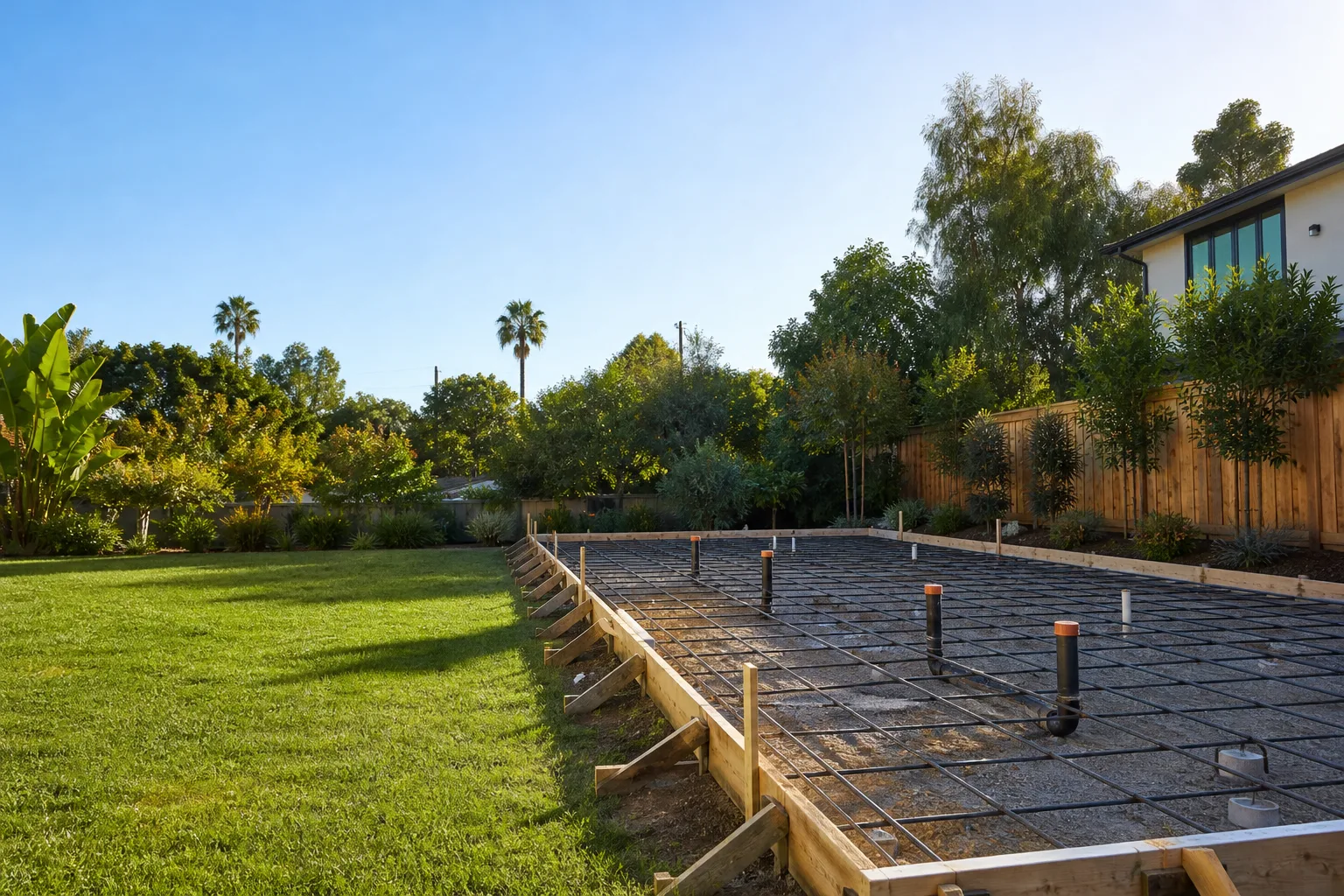
- Have the structural engineer issue a revised foundation plan. For expansive clay, that typically means a post-tensioned slab or a deepened perimeter footing. For caliche, it means a detailed excavation note, an over-excavation specification, and possibly a pier design if the caliche sits close to the surface.
- Submit as a plan check amendment, not a new application. Revised foundation plans that respond to a written soils report are handled as plan check corrections at the City of North Las Vegas, not as a new submittal. You keep your plan check number, your place in the queue, and your original site plan.
- Budget the foundation line before signing anything. Engineered foundation premiums on North Las Vegas ADU projects typically run $4,500 – $12,000 over a standard slab depending on the soil condition and the ADU size.
We’ve watched owners panic at a soils finding and re-bid the entire project. That’s the wrong move. The report is information, not a setback. If you haven’t commissioned a soils report yet, do it before the foundation plans are drawn, not after.
Existing Electrical Service Can’t Carry the ADU Load
An ADU typically adds 60 to 100 amps of load to a property’s existing service. A North Las Vegas house with a 100-amp panel from the 1990s or early 2000s frequently has no spare capacity after the addition, and NV Energy requires a service upgrade before the ADU can be energized. This is a common bottleneck on New Detached ADU in North Las Vegas projects and one of the most schedule-sensitive.
The upgrade path looks like this:
- Load calculation first. A licensed electrician runs the calculation against the existing service and the proposed ADU load. If the existing service can carry the addition with a subpanel, no upgrade is needed.
- NV Energy service application. If the service must be upgraded, NV Energy reviews the application and issues a service order. In North Las Vegas, this typically runs four to eight weeks from application to energized service, depending on the scope of the upgrade and whether a new meter pedestal is required.
- Panel upgrade cost ranges (North Las Vegas). A 100-amp to 200-amp panel upgrade with new meter socket and grounding typically runs $2,800 – $5,500. A full service upgrade to 400 amps for larger ADUs or dual-electric-vehicle households typically runs $6,500 – $12,000, including the utility coordination.
- Schedule the upgrade early. Because the upgrade can take a month or more on the utility side, the right time to file is immediately after the ADU permit is issued, not the week before final inspection.
Electrical service upgrades are not a DIY item. The panel carries enough current to be lethal, and NV Energy and the City of North Las Vegas both require licensed electrician sign-off. Treat the upgrade as a documented, phased scope item from day one.
Sewer Capacity Hold on Your North Las Vegas Property
A sewer capacity hold is exactly what it sounds like: the City of North Las Vegas has reviewed your ADU’s added fixture load and determined that the sewer main serving your block cannot accommodate the additional discharge without an improvement. The permit is technically complete, but it cannot be issued while the hold is active.
Here’s what a capacity hold actually means and how it typically resolves:
- It is usually a district-level constraint, not a property-level defect. The hold is triggered by the capacity of the trunk line, which is shared with all upstream parcels.
- Timeline varies. Some holds clear in 30 to 60 days as the city completes its capacity modeling. Others remain in place for a full planning cycle while a capital improvement is scheduled. The city will issue the projected release date on request.
- A septic variance is a narrow path. Clark County and the City of North Las Vegas will consider a septic variance for some ADU projects, but the parcel generally must be outside the sewer service area, which most North Las Vegas ADU parcels are not. In practice, the viable path on an in-service-area parcel is to wait out the hold or, in rare cases, to petition for an interim connection agreement.
- Plan for the wait. If the hold is projected to be long, the design and permit work can continue, but site prep and construction cannot start. Address the hold openly with your design team, not after excavation has begun.
We’ve seen owners caught by surprise by a capacity hold because they assumed a complete permit was an issued permit. Confirm sewer capacity early with the city, ideally at the pre-application stage.
Drainage, Grading, and the Desert Slope Problem
North Las Vegas gets about 4 inches of rain a year. That number is deceptive. The rain arrives in short, intense events, and a flat lot with no positive drainage can pond a surprising volume against a new ADU foundation in a single afternoon. On the sloped parcels in the north and northwest parts of the city, the grading plan has to divert sheet flow before it reaches the new structure.
What to check on the site plan:
- Positive drainage away from the ADU footprint at a minimum 2% slope. A grading plan that complies only at the finished slab is not enough; the perimeter finish grade must also pitch away.
- Retaining walls on sloped parcels. If the ADU cuts into a slope, a retaining wall is likely required. North Las Vegas retaining walls over 4 feet typically require an engineered design and a permit, adding $6,000 – $18,000 to the site work depending on length and height.
- Downstream discharge point. The grading plan must show where the water goes. Discharging onto a neighbor’s parcel is a common cause of plan check corrections.
Grading problems rarely show up as a permit denial. They show up as a failed final inspection or a call from your neighbor two rainy seasons in. Address the grading plan during design.
How to Amend a Plan Set Without Restarting Plan Check
The single most valuable skill in ADU site prep is knowing which changes require a new plan check application and which can be handled as an amendment. In our experience, roughly nine out of ten post-submittal site prep problems in North Las Vegas fall into the amendment category. The tenth, which involves either a change of use, a parcel boundary change, or a fundamental footprint change that breaks a setback, requires a re-submittal.
The amendment workflow:
- Document the problem in writing. A soils report, a utility locate map, an LVVWD denial letter, or an NV Energy service order. Whatever the finding is, the amendment package is built around the paper, not a verbal explanation.
- Have the engineer of record revise the specific sheet. The amendment touches the affected sheet only. A revised foundation plan does not require a new site plan.
- Submit as a plan check correction through the City of North Las Vegas portal. The plan check number is retained. The reviewer sees the correction in context, which is faster than a fresh review of a fresh set.
- Track the review clock. Amendment reviews at the City of North Las Vegas typically clear in two to four weeks, versus eight to twelve for a new submittal.
- Resolve the site cost before resuming construction. If the amendment changes scope, the price changes in writing, not on a verbal change order at the fence line.
The amendment path matters most on Garage Conversion ADU in North Las Vegas projects, where existing utility placement inside the conversion footprint is the most common source of post-submittal corrections. A conversion that finds an existing panel or sewer line inside the proposed bathroom location needs the plan updated, and it’s an amendment, not a restart.
Ten Site Prep Failures, At a Glance
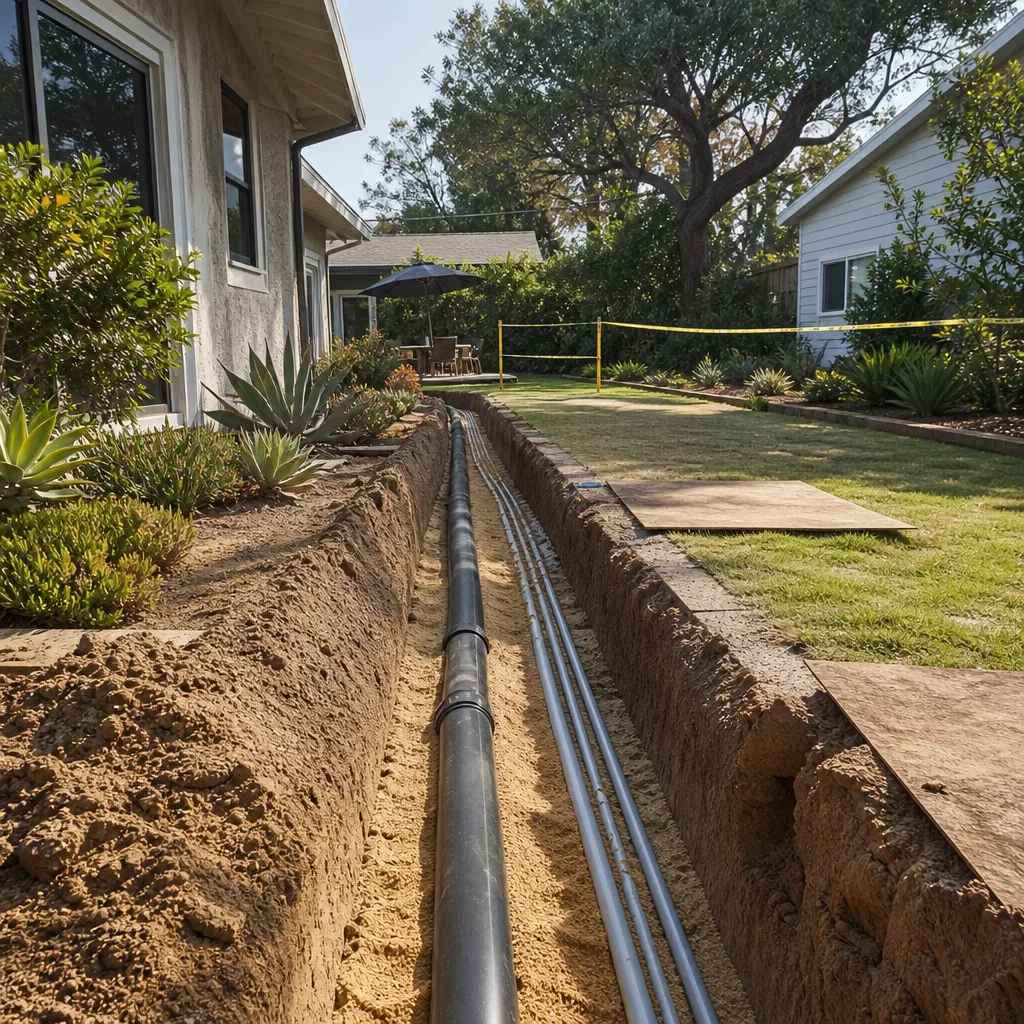
Owners planning an ADU often ask what the full list looks like. Here are the ten failures we’ve encountered most often on North Las Vegas lots, in approximate order of frequency:
- Utility locate conflict with the proposed footprint.
- LVVWD meter upgrade denial for insufficient line pressure.
- Soils report finding expansive clay requiring an engineered slab.
- Soils report finding caliche requiring over-excavation and a hardened foundation specification.
- Existing electrical service too small for the ADU load.
- NV Energy service upgrade timeline longer than anticipated.
- Sewer capacity hold at the district level.
- Grading plan that fails to show positive drainage away from the footprint.
- Retaining wall required on a sloped parcel, not accounted for in the site work budget.
- Driveway or access width inadequate for construction equipment, forcing a hand-excavation premium.
Each of these is resolvable. What varies is the phase at which each is typically caught, which drives the cost, and whether the fix is an amendment or a change order. Prefab systems from brands like Cover or Dvele don’t remove these problems; they still require a site foundation, a utility connection, and a compliant drainage plan. The factory-built unit reduces on-site construction time, not the site work scope.
Common Mistakes to Avoid
- Commissioning the soils report after the foundation is drawn. The soils report determines the foundation design, not the other way around. Drawing the foundation first and then testing the soil almost always adds a revision cycle.
- Treating NV811 as the whole picture. NV811 covers public utilities. Private lines on your lot (irrigation, private sewer, landscape electrical) require a private locator, and they are the most common source of unexpected trench conflicts in North Las Vegas.
- Assuming a complete permit is an issued permit. A project can sit at 100% plan review and still be blocked by a sewer capacity hold or an LVVWD meter condition. Confirm both before construction scheduling.
- Filing the NV Energy service upgrade last. The upgrade is often the longest lead of the utility items. File it the day the ADU permit is issued, not the month before final inspection.
- Ignoring the grading plan on a flat-looking lot. Even a 1% grade across a North Las Vegas lot can pond water against a new foundation. The grading plan is not optional paperwork; it’s the difference between a dry crawlspace and a call to the builder.
- Redrawing the whole ADU to fix a single utility conflict. Shifting a footprint 18 inches, or amending a foundation sheet, is a fraction of the time and cost of a full re-submittal. Get the amendment path on the table before the redesign conversation starts.
- Accepting a verbal change-order for a site fix. The scope and price change should be on paper before any excavation resumes. Under our Haven Standard Clause 1, that written price happens before any work starts, not after.
When to Call a Professional
Some of these problems are within reach for a careful owner to investigate. A utility locate, a soils report, an LVVWD pressure reading, an NV Energy service calculation: all of those are requests made by phone or through a portal, and the paper trail is the deliverable. The moment the problem starts touching the foundation design, the electrical service capacity, the grading plan, or the plan-check amendment itself, the cost of getting it wrong climbs faster than the cost of getting it right. We’ve watched owners spend five figures trying to save a four-figure professional fee. If you’re seeing more than two of the ten failures above, or any one of them is landing after construction has started, it’s worth getting an assessment before the next trench is dug.
Ellery ADU Studio North Las Vegas offers free estimates in North Las Vegas. Every project carries a written price before any work starts, a documented photo record on every visit, and our 365-Day Done Right Promise in writing. Our technicians have up to 11 years of experience on site prep and utility work. Call (866) 403-8955 to schedule your free estimate.
Frequently Asked Questions
The cost depends almost entirely on the phase the problem is caught in. A utility conflict found at design stage is typically a $600 – $1,800 surveyor and engineering amendment. The same conflict found during trenching runs $2,500 – $6,000 in extra excavation and utility relocation. A foundation change after the slab is poured can run $8,000 – $15,000. Call (866) 403-8955 for an exact quote on your specific lot; estimates are free.
Not usually. Most site prep problems (utility conflicts, soils-driven foundation changes, grading corrections) are handled as plan check amendments through the City of North Las Vegas, not as new applications. You retain your plan check number and your place in the queue. The exceptions are fundamental changes to the footprint, use, or parcel lines. Call (866) 403-8955 to talk through which path your correction falls into.
Typically four to eight weeks from application to energized service, depending on scope. A 100-amp to 200-amp panel upgrade with a new meter socket is usually at the shorter end. A full 400-amp service with a new meter pedestal is at the longer end, plus any utility-side capacity work. File early in the project to avoid holding up the final inspection.
No. Prefabricated ADU systems from Cover, Dvele, Boxabl, and Mighty Buildings each still require a site-built foundation, a utility connection, and a grading plan. The factory eliminates on-site framing time, not the site work. The City of North Las Vegas still reviews the site plan and the soils-driven foundation design on the same schedule.
A sewer capacity hold is a district-level restriction on new connections on a given trunk line while the city verifies or improves capacity. In North Las Vegas, some holds clear in 30 to 60 days; others remain in place for a full planning cycle. The city will issue a projected release date on request. A septic variance is generally not a viable path on a parcel inside the sewer service area. Call (866) 403-8955 if you’ve received a hold and want to understand your options.
The rule of thumb: if the change touches only the sheet the problem affects, and the footprint, use, and setbacks don’t change, it’s an amendment. If the footprint shifts in a way that breaks a setback, the use changes, or the parcel line changes, it’s a re-submittal. In our experience, nine out of ten site prep corrections in North Las Vegas fall into the amendment category. See the Ellery ADU Studio North Las Vegas home page for an overview of how our design-build process handles amendments under the single contract.
The Bottom Line
Site prep problems on an ADU in North Las Vegas are not exceptions; they’re the normal case. The differentiator between a $2,000 fix and a $15,000 fix is almost never the problem itself. It’s the phase it’s discovered in. Get the soils report, the utility locate, the LVVWD pressure check, the NV Energy load calculation, and the sewer capacity confirmation done at the design stage, before any drawing gets its final revision. When a correction does turn up, treat it as a plan check amendment through the City of North Las Vegas, not as a full re-submittal. The permit set is the product; every problem in this guide is a plan set correction, not a project restart. Call (866) 403-8955 for a free estimate on your North Las Vegas ADU, or to get a second opinion on any written estimate you already have in hand. Every quote we issue is a written price before any work starts, and every visit comes with a documented photo record.
Written by the team at Ellery ADU Studio North Las Vegas.