Last updated November 18, 2026
ADU Site Prep & Utilities Maintenance Schedule: What to Do and When
A new ADU sewer lateral in North Las Vegas runs through soil that expands and contracts with temperature swings that can hit 80°F between a January night and a July afternoon. The standard maintenance advice you’ll find online – “snake the line every five years” – was written for Chicago clay, not Mojave caliche. The interval that actually matters here is different, and so is the failure mode. Most ADU owners never receive a maintenance record for the utilities their project added: the dedicated meter, the new service lateral, the independent sewer connection. This guide gives you that record, organized by system and interval, so you know what to check, when, and what a real problem looks like before it becomes an excavated line item.
Quick Answer
In North Las Vegas, ADU utility systems need annual electrical inspection (weatherhead, meter socket, subpanel terminations), bi-annual water service checks (backflow preventer, isolation valve, pressure reading), a sewer CCTV inspection every 3-4 years rather than 5, annual gas connection and drip leg inspection, and a post-monsoon drainage walk every summer. These intervals reflect local soil, thermal cycling, and the pattern of high-intensity rain events, not a generic national schedule.
Table of Contents
- Why North Las Vegas Utilities Need a Different Schedule
- Electrical: Annual Service Entrance and Subpanel Inspection
- Water Service Lateral: Bi-Annual Checklist
- Sewer Lateral: CCTV Intervals and What Fails First
- Gas Service: Annual Connection and Drip Leg Inspection
- Site Drainage: The Post-Monsoon Walk
- The Full Maintenance Calendar
- What Documentation You Should Keep
Why North Las Vegas Utilities Need a Different Schedule
Most maintenance guidance is written for temperate climates with steady rainfall and soil that stays roughly the same moisture content year-round. North Las Vegas is not that. The Mojave basin here produces three conditions that change everything about how utilities age:
- Thermal cycling on exposed infrastructure. Summer highs regularly pass 110°F while winter nights drop into the 30s. That swing works on metal conduit, meter sockets, and the terminations inside a subpanel. Loose lugs and hairline cracks in conduit fittings show up here faster than in milder climates.
- Expansive and caliche-laden soil. The soil column under much of North Las Vegas moves with moisture and temperature. A buried sewer lateral experiences shear stress at fittings and joints that a lateral in stable clay does not. Caliche layers can also deflect root growth sideways into pipe seams.
- Concentrated rainfall. North Las Vegas gets most of its precipitation in 4 to 6 high-intensity events a year, often during monsoon season from July through September. Drainage systems sized for average flow get tested by events that deliver a large share of the annual total in a few hours.
When we design and permit an ADU, the utility infrastructure we document is specific to these conditions. But the maintenance that follows the final inspection is where most owners lose the thread. A single contract that includes site prep and utilities – which is how we structure every project, drawings through final inspection – gives you a starting record. What this guide builds is the ongoing one.
If you’re still in the planning stage and want to understand how the design and permit process works before utilities enter the picture, our ADU Design & Permitting in North Las Vegas page walks through the permit set step by step.
Electrical: Annual Service Entrance and Subpanel Inspection
An ADU typically gets its own meter and service entrance, or a subpanel fed from the main service. Either way, the connection points are the parts that age fastest in North Las Vegas. NV Energy’s service entrance requirements dictate how the weatherhead, mast, and meter socket are installed; the annual inspection is about verifying those connections haven’t drifted since the day the utility signed off.
What an annual electrical inspection should cover:
- Weatherhead connection. The point where the service drop meets your mast. Look for frayed insulation, a pulled drip loop, or a mast that’s no longer plumb. Thermal expansion of the conductors plus wind load moves this assembly over time.
- Meter socket and terminations. With power off, an electrician checks lugs for torque and looks for discoloration that signals heat. Aluminum conductors in particular loosen under thermal cycling. This is a 15-minute check that prevents a meter base failure.
- Subpanel terminations. Every breaker lug and the neutral/ground bar get a torque check. Loose neutrals cause flickering and are a common cause of nuisance trips in ADU subpanels.
- Grounding electrode. Verify the ground rod and bonding jumper are intact. Soil movement can pull a ground clamp loose.
- GFCI and AFCI test. Press the test buttons on every protected circuit. AFCI breakers protect against the arc faults that older wiring in converted spaces is prone to.
Because 110°F-plus summer days are hard on terminations, an annual check is the right interval here. Schedule it in spring, before the load peaks with air conditioning. Nothing in this section is a DIY task – service entrance equipment carries line voltage and the terminations are behind a sealed meter. This is work for a licensed electrician, every time.
Water Service Lateral: Bi-Annual Checklist
The water line from the main to your ADU carries three components that need eyes on them twice a year. The Las Vegas Valley Water District requires a backflow preventer on all new ADU connections, and that device has an annual or bi-annual testing rhythm depending on the assembly type. Your isolation valve and pressure regulator need the same attention.
Bi-annual water service checklist:
- Backflow preventer test. LVVWD requires these assemblies tested to confirm the check valves still hold. A failed backflow preventer can contaminate the domestic supply, so this isn’t optional paperwork – it’s a health safeguard. Keep the test report with your utility record.
- Isolation valve operation. Open and close the shutoff valve on the ADU’s service line. A valve that hasn’t been turned in years can seize, and a seized valve during a leak is an emergency. Exercise it twice a year.
- Pressure gauge reading. North Las Vegas distribution pressure runs high in some service areas. A pressure regulator protects fixtures and the water heater. If your gauge reads well above the 50-80 psi range fixtures are rated for, the regulator needs service. High static pressure also accelerates valve wear.
- Visible leak check. Walk the line’s path where it’s accessible. Wet spots, greener grass over the buried line, or a jump in your water bill all point to a slow leak before you’d notice it indoors.
If you’re converting an existing garage and adding a new water connection, the backflow and pressure details get set during site prep. Our Garage Conversion ADU in North Las Vegas page covers how that connection is scoped inside a conversion project.
Sewer Lateral: CCTV Intervals and What Fails First
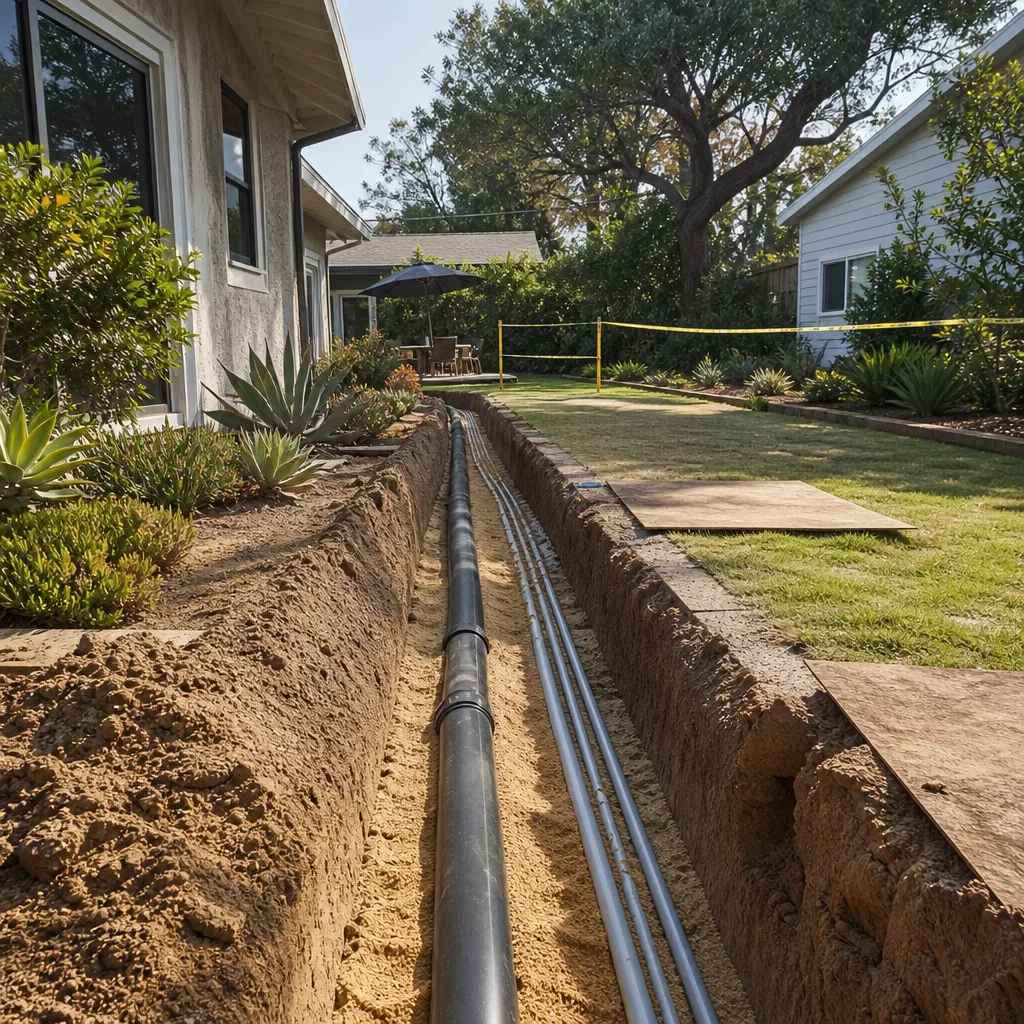
Here’s where the national advice fails hardest. The “snake it every five years” rule assumes a stable soil profile. Under North Las Vegas conditions, a camera inspection every 3 to 4 years is the interval we recommend, and a camera tells you more than a snake ever will. A snake clears a blockage; a camera shows you the joint that’s about to fail.
What early-stage trouble looks like on camera:
- Root intrusion at a joint. Fine root hairs entering a pipe seam look like a small brush or spider web fanning from one point. This is early. It’s caught and cleared before it becomes a matted blockage.
- A collapsed or offset joint. Two pipe sections that no longer line up show a visible step in the camera footage. In moving soil, an offset joint is the warning sign before a full collapse. If water drains slowly and the camera shows an offset, that lateral needs repair now, not later.
- Bellies and low spots. A section of pipe that sags holds standing water. In a location with minimal slope tolerance, a belly fills with debris and becomes the recurring clog point.
- Caliche intrusion and scale. Mineral buildup narrows the effective diameter over time. Camera footage shows the buildup; a snake just pushes through it and the problem returns.
Schedule the CCTV inspection in the dry season so the footage is clear. Ask for the video file, not just a verbal summary – that clip becomes your baseline. When the next inspection comes, you compare against it and see whether a joint has moved. This is exactly the kind of documented record we include on every project visit, and it’s the habit worth continuing after the warranty period ends.
Gas Service: Annual Connection and Drip Leg Inspection
If your ADU uses a gas water heater, range, or furnace, the gas service needs an annual look at the appliance connections, the drip leg, and – if you have one – the seismic shutoff valve. Southwest Gas sets the connection standards; annual inspection verifies nothing has loosened or corroded since commissioning.
Annual gas service inspection items:
- Appliance connection leak check. A soap-solution or electronic leak detection test at each flexible connector. Flexible connectors degrade, and the connector is the most common leak point.
- Drip leg cleanout. The sediment trap (drip leg) below each appliance catches debris and moisture carried in the gas line. It gets inspected and cleared. A clogged drip leg sends debris into the appliance’s gas valve.
- Seismic shutoff valve test, if installed. Some installations include an automatic shutoff that trips on ground movement. Verify it still functions and resets correctly. If none is fitted, ask whether your assembly type warrants one.
- Vent and flue inspection. Confirm the flue is clear and properly connected. This one is a safety matter, not just a performance matter.
Gas work carries real risk. A small leak you can’t smell is still a leak. Do not attempt your own leak test with a match or a flame, and do not ignore a sulfur smell near a connection – call the gas utility and a licensed technician. The inspection above belongs in a professional’s hands. Under our site prep and utilities scope, the gas connection is commissioned and documented at the end of construction; the annual check keeps that documentation current.
Site Drainage: The Post-Monsoon Walk
Drainage is the utility most ADU owners think about least and regret most. North Las Vegas receives the bulk of its annual rain in a handful of intense events, mostly July through September. Swales, area drains, and downspout extensions that perform perfectly in a light rain can overwhelm in a monsoon downpour. The walk you do after the first big storm each summer tells you more than a dry-season inspection ever could.
Post-monsoon drainage walk:
- Check swales for ponding. Water that sits for more than a day after rain means the swale grade has flattened or filled with sediment. Standing water next to an ADU foundation is the start of a much larger problem.
- Clear area drains and grates. Debris from the storm collects at the low point. Clear it before the next event.
- Verify downspout extensions reach away from the foundation. A downspout that dumps at the slab edge concentrates water exactly where you don’t want it.
- Look for soil erosion at the ADU perimeter. Channelized runoff leaves visible ruts and can undermine a footing over seasons. Grade should slope away from the structure on all sides.
- Check the overflow path. Heavy rain should flow to a defined path, not toward a neighbor’s property or the ADU door.
This is a walk you can do yourself without risk – it’s visual inspection, not repair. Fixing grading, replacing a crushed drain line, or reworking a swale is contractor work. Our New Detached ADU in North Las Vegas page explains how drainage and site grading get scoped into a detached build before a shovel hits the ground.
The Full Maintenance Calendar
Here’s the schedule in one place, organized by system and interval. Print it, or set reminders around the seasons that matter here: spring for electrical (before load peaks), late spring and fall for water, dry season for sewer camera work, and immediately after the first monsoon event for drainage.
- Electrical (annual, spring): weatherhead, meter socket, subpanel torque check, grounding, GFCI/AFCI test.
- Water service (bi-annual, spring and fall): backflow test per LVVWD, isolation valve exercise, pressure gauge reading, leak walk.
- Sewer lateral (every 3-4 years, dry season): CCTV camera inspection with saved video file, comparison against prior footage.
- Gas service (annual): appliance connection leak check, drip leg cleanout, seismic shutoff test if installed, flue inspection.
- Site drainage (post-monsoon and pre-monsoon): swale ponding check, drain clearing, downspout reach, perimeter erosion check.
The core reason this schedule exists at all: most ADU utility infrastructure was never documented as a maintainable system because it was split across a designer, a separate contractor, and the utility companies. A single contract from design through final inspection is what makes a coherent record possible. That’s the model we work under, and it’s why every one of the 900-plus ADUs we’ve designed, permitted, and built since 2015 carries a written price before work starts and a documented photo record when work is complete.
What Documentation You Should Keep
A maintenance schedule is only as good as the records you compare against. Here’s what belongs in your ADU utility file:
- The permit set and as-built drawings. These show where every lateral, conduit, and drain actually runs – essential when a future check needs to locate a line.
- Backflow test reports, dated. LVVWD wants them, and the history shows the assembly’s condition over time.
- Sewer camera video files, dated. Each inspection compared against the last. This is how you catch a joint offset before it collapses.
- Electrical torque and test records. A photo of the subpanel terminations at each inspection, plus the electrician’s notes.
- Gas service records. Connection, drip leg, and shutoff test dates, with the technician’s findings.
- The written workmanship record. Under the Haven Standard, the written price and the photo record are part of the project file from day one. Keep them with the utility records – the as-built drawings live in the same file.
When you have this file, a future buyer of your property gets something valuable: proof the ADU’s utilities were maintained, not just installed. That’s a stronger position than a verbal “it’s been fine.”
Common Mistakes to Avoid
- Following a five-year sewer interval here. That schedule was written for stable clay. In North Las Vegas’s moving, caliche-heavy soil, a camera inspection every 3 to 4 years catches joint offsets and root intrusion while they’re still cheap to fix.
- Skipping the backflow test because the water runs fine. A backflow preventer that fails doesn’t announce itself – it silently lets contamination cross into the domestic supply. LVVWD requires the test for a reason.
- Never exercising the isolation valve. A shutoff valve that hasn’t been turned in five years can seize. When a pipe leaks at 2 a.m., a seized valve turns a repair into a flood.
- Inspecting drainage in the dry season only. Swale problems show up during monsoon events. Walk the site right after the first heavy rain of the summer, when the actual flow path is visible.
- Ignoring electrical discoloration. A browned meter socket or a warm subpanel face is the earliest sign of a loose termination. In the thermal swing of North Las Vegas, that check is annual, not optional.
- Cleaning a gas drip leg yourself or skipping it. A clogged drip leg pushes debris into the appliance’s gas valve. This is professional work – a leak is a genuine hazard.
- Losing the camera footage and as-builts. Without dated video and drawings, each future inspection stands alone. You can’t tell a new problem from an old one, and neither can your technician.
When to Call a Professional
Some of this schedule is a visual walk you can do yourself. Some of it is not. Call a professional immediately when you smell gas near an appliance, when your electrical panel is warm or discolored, when water pressure at the ADU drops suddenly, or when the sewer drains slowly after a recent camera inspection flagged an offset joint. Those are stop-now situations, not next-season items.
For the scheduled work – the annual electrical torque check, the bi-annual backflow test, the camera inspection, the gas service check – the question is who holds the record. A studio that designed and permitted the utilities is in a position to inspect them against the as-builts, and that’s a cleaner arrangement than starting fresh with a different contractor every year. Ellery ADU Studio North Las Vegas offers free estimates in North Las Vegas – call (866) 403-8955, and a live person answers around the clock.
Frequently Asked Questions
Every 3 to 4 years, which is more frequent than the five-year interval you’ll see in national guides. North Las Vegas soil expands and contracts with large seasonal temperature swings, which stresses joints and attracts roots into seams. A camera catches an offset joint or early root intrusion while it’s a minor repair.
Yes. LVVWD requires a backflow preventer on all new ADU water connections, and the assembly needs periodic testing to confirm it still holds. Keep each dated test report in your utility file, and treat the bi-annual check as part of the cost of owning an ADU, not an optional extra.
A reasonable annual budget for the scheduled items – electrical inspection, water checks, gas inspection, and a drainage walk – runs in the low hundreds of dollars, with the sewer camera inspection adding to the year it falls on. Exact pricing depends on line lengths and assembly types. Call (866) 403-8955 for a written estimate on your specific setup before scheduling anything.
No. Service entrance terminations, subpanel lugs, and gas appliance connections carry real risk – line voltage and combustible gas. A visual walk for discoloration or a sulfur smell is fine; testing, torquing, and leak checking belong to licensed technicians. This isn’t a liability disclaimer, it’s the way these systems fail.
Because the rain arrives in 4 to 6 high-intensity events a year, mostly in monsoon season, rather than as steady rainfall. A drainage system that handles light rain can be overwhelmed in an hour. That’s why the meaningful inspection is the walk right after a heavy storm, not a dry-season check.
You lose the baseline. Without the as-built drawings, dated camera footage, and test reports, each future inspection stands alone, and a slow-developing problem looks like a sudden one. The record also matters at resale, where documented utility maintenance is stronger evidence than a verbal assurance. Call (866) 403-8955 to talk through what your file should contain.
The Bottom Line
ADU utility infrastructure has a maintenance lifecycle, and in North Las Vegas that lifecycle runs on a faster clock than the national advice assumes. Annual electrical checks, bi-annual water inspections, a sewer camera every 3 to 4 years, annual gas service, and a disciplined post-monsoon drainage walk – five systems, five rhythms, all tied together by one thing: the written record. Get the schedule, keep the documents, and the systems that make your ADU livable stay that way. The best time to have done this was at final inspection; the second-best time is now. Start from the Ellery ADU Studio North Las Vegas home page to see how site prep and utilities fit the larger project, then call (866) 403-8955 for a free estimate.
Written by the team at Ellery ADU Studio North Las Vegas.